Prayer is one of the most talked-about aspects of the Christian life—and often one of the most misunderstood. In this episode, Dillon McCurdy and Pastor Drew Rogers discuss their new book, The God Who Hears, a practical guide built around the “ABCs of Prayer.” Together they explore what biblical prayer looks like, how prayer strengthens our relationship with God, and why Paul's command to “pray without ceasing” is more attainable than many Christians realize. This conversation is filled with practical insights for believers who want to move beyond routine prayers and cultivate a genuine, ongoing relationship with the Lord.
- The God Who Hears is the second book out of their publishing effort, an A-to-Z guide to prayer with short chapters drawn from a Wednesday night sermon series and priced as low as Amazon allows, because the aim is getting resources into people's hands rather than making a living off writing; Drew Rogers said the point is not prayer performed as a duty but a relationship with God — what he hopes readers walk away with is that God is real and wants a real relationship with them, and teaching these principles is what convinced him Paul's admonition to "pray without ceasing" is genuinely possible when there is a true love relationship with God.
- The series and the book came out of a sheet Michael Williams handed out at a prayer camp in the UP — one point and one scripture per letter — which Drew developed and taught for 13 weeks as "practical steps towards biblical prayer," alongside Blackaby's Experiencing Prayer with Jesus, for 28 weeks total on prayer.
- The big shift was moving the focus off praying for specific physical needs and onto adoration and God's kingdom and will, following the model Jesus gave; Drew said prayer is not an opportunity to convince God to help but an opportunity for God to lay his agenda on his heart — and the less they prayed for the physical needs to be resolved, the more they saw those needs answered.
- Chapters they highlighted: A for adoration, B for bread for today (spiritual nourishment, not groceries), K for knowing the God who hears, P for professing your identity in Christ, Q for questions for God, casting your cares, thanksgiving, and a list of over 650 names of God; Dillon McCurdy added that praying in Jesus' name means praying in alignment with him and in the authority he gives, not attaching a tagline to a sentence.
- At the church they changed Wednesday nights to teach a lesson, then spread out for ten minutes of individual prayer in adoration and for spiritual bread before bringing requests — "praying before we prayed" — and opened the building at 9:00 on Sunday mornings; some people loved it, others stopped coming, and Drew's counsel is to keep doing what the Lord is leading you to do.
- Over about six months they saw answers they called impossible: Pearly's cancer gone and hospice leaving, a baby born at two pounds now with a clean bill of health, Drew's wife's masses gone or non-cancerous, Mrs. Gibbs' two aneurysms gone, and a grieving widower released from condemnation after prayer.
- Dillon tied prayer to spiritual warfare — Daniel continuing in prayer while the messenger was held up — saying prayer is part of the battle, and that the body of Christ praying individually and collectively has great power and is the means by which God seems to work.
"Prayer is not an opportunity for me to convince God to help me, but it's an opportunity for God to lay his agenda on my heart."Pastor Drew Rogers
"What we were doing is we were praying before we prayed, so that my heart is aligned and my heart is ready to actually pray for the physical things with the right heart attitude."Pastor Drew Rogers
"To pray in the name of Jesus is to pray in alignment with Jesus, but also to pray in the authority that Jesus has and gives."Dillon McCurdy
- 1 Thessalonians — Paul's admonition to the Thessalonians to "pray without ceasing" (paraphrased)
- Matthew 6 — the model prayer Jesus gave: "Our Father," "thy kingdom come, thy will be done in earth as it is in heaven," "give us this day our daily bread," and Jesus saying it is the Gentiles who seek after food (paraphrased)
- Philippians — Drew said Paul talks about learning him and knowing him, not just learning about him (paraphrased)
- Romans chapter 8 — described as five questions the devil can't answer
- Psalms — "I will enter his gates with thanksgiving in my heart, I will enter his courts with praise" (paraphrased)
- Psalms — "This is the day the Lord has made; I will rejoice, for he hath made me glad" (paraphrased)
- "Abba, Father" — coming to God as a child (paraphrased)
- "Every good and perfect gift comes down from the Father of lights" (paraphrased)
- "If thou shalt call upon the name of the Lord thy God, thou shalt be saved" (paraphrased)
- Jesus saying he wanted his house to be called a house of prayer (paraphrased)
- Casting your cares on God (paraphrased)
- Daniel — Daniel continuing in prayer while the angel bringing his message was held up by an adversarial angel until Michael assisted (paraphrased)
- "Where two or three agree" (paraphrased)
- A time for mourning, and the Holy Spirit comforting us (paraphrased)
- Joshua — the book behind the sermon series that became The God Who Leads
- The God Who Hears — the book discussed, written chiefly by Drew Rogers with Dillon McCurdy's name on it; $8 paperback, about 99 cents on Kindle, and searchable on Amazon under "The God Who Hears" by Drew Rogers.
- The God Who Leads — their first book, based on a sermon series from the book of Joshua, around $6 or $7; Drew said finishing the second book made him want to go back and rewrite it.
- In the Midst Publishing — the informal name for their publishing effort; they use Kindle Direct Publishing.
- The book's website — Dillon pointed listeners there for more information and said the sermons corresponding to each chapter will be posted, likely as a YouTube playlist (the auto-captions garble the domain, rendering it as "godhair hearers.com," "godhoohars.com," and "godheroes.com").
- Michael Williams — Drew's friend who hosts a prayer camp in the UP and handed out the outline, possibly called the ABCs of prayer, that started the series.
- Experiencing Prayer with Jesus, by Blackaby — Drew taught through it alongside the ABCs of prayer and said if you are going to buy any book on prayer, buy this one rather than The God Who Hears.
- The Bondage Breaker, by Neil T. Anderson — source of principles Drew used in the chapter on professing your identity in Christ.
- Tower Baptist Church — where Drew's brother and assistant pastor is closing in on a year; attendance went from 15 people to 80 on a recent Sunday.
- Jacob Bis (spelling uncertain in the auto-captions) — a deacon who was doing pulpit supply with his wife at a church in Hessel.
- A church in Colombia that Drew's dad helped plant last year — 110 people attended its one-year anniversary.
- Rogers City, Michigan — where Pastor Drew serves.
- Brian Free and Assurance — Dillon quoted the line "I'm a soldier winning battles by fighting on my knees," and also "prayer moves the heart that moved the hand that moves the world" from a song he could not name.
- Pearly and Mrs. Gibbs — church members named in the answered-prayer accounts.
Take it further
- Drew described prayer as developing a relationship with God rather than performing a duty. Which of the two better describes your prayer life right now?
- The shift they made was praying for God's kingdom and will before bringing physical needs. What would change about your prayer time if you started there?
- Drew said prayer is God laying his agenda on your heart rather than you convincing God to help. Where have you been trying to convince God instead of listening for his agenda?
- Chapter A is adoration, and Drew said the more we lose our awe of God, the more we lose touch with all other spiritual disciplines. When did you last simply stand in awe of God before asking him for anything?
- Dillon talked about thanksgiving in a culture of complaining. What good news, personal or professional, could you bring to God in thanksgiving this week?
- Drew admitted the change at his church met resistance and that some people stopped coming. Where is God leading you to change how you pray, even if the people around you do not join in?
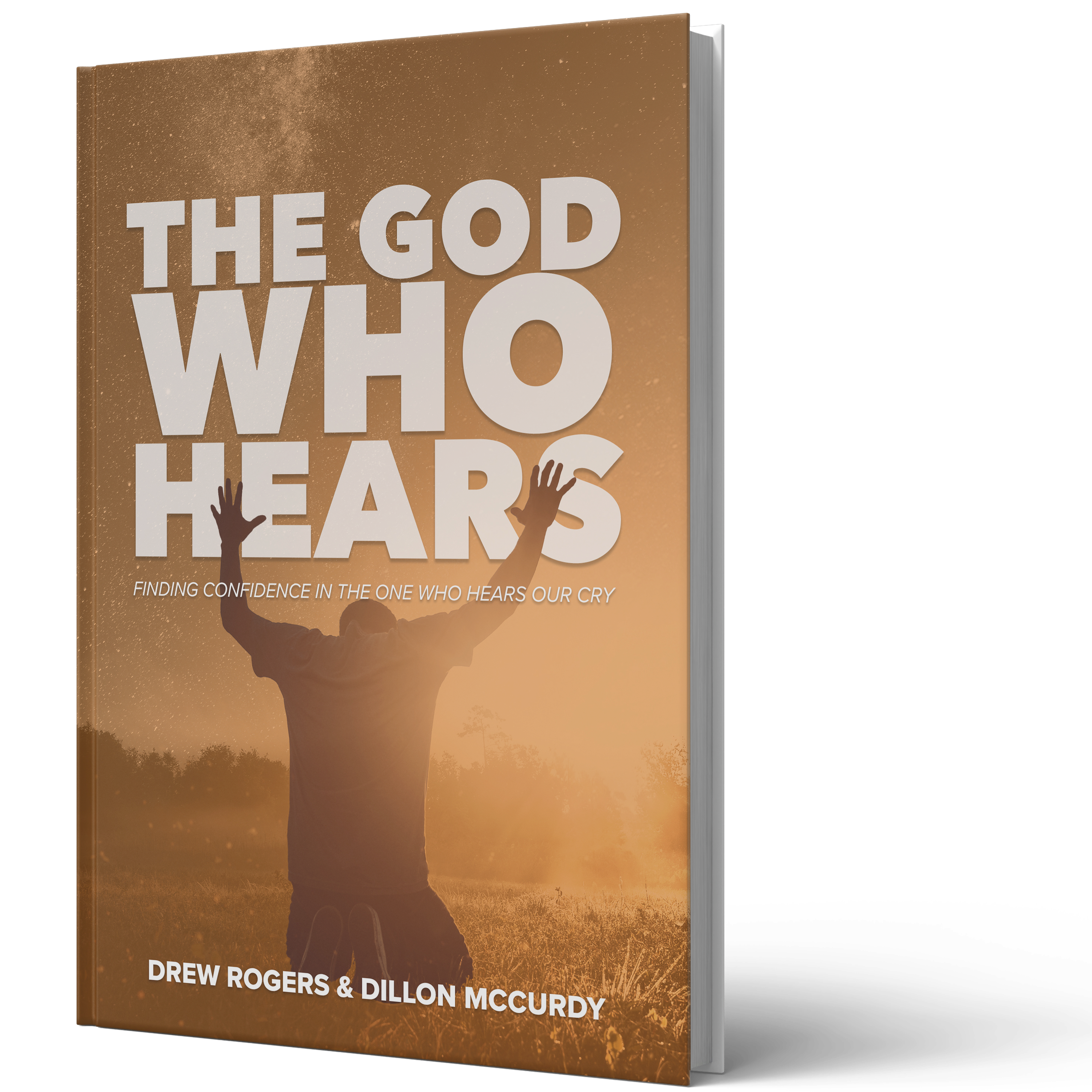
The God Who Hears
An invitation to pray with confidence — twenty-six postures of the praying heart, from Adoration to the quiet place where you rest and remember that He is God.
Never miss an episode
New conversations land every few weeks. Drop your email and we’ll send each one as it goes live.